| 
SHAGBARK
HICKORY
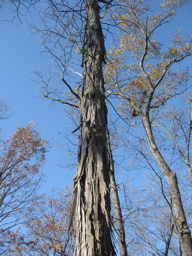
Shagbark Hickory trees are some of the prettiest
trees I know. On our farm there are more than fifty of these
trees, many well over twenty years old. They are unique
in the hardwood forest and standout because of their "shaggy"
trunks.
Classification:
Carya ovata (shagbark hickory): occurring in pairs or solitary;
It grows well in both wet and dry areas, but prefers well-drained
soils. It is a slow-growing long-living tree.
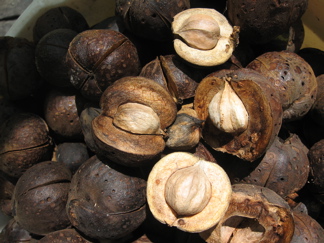
The nuts, largest of all the hickory nuts, are sweet and
edible and produce seedling trees readily.
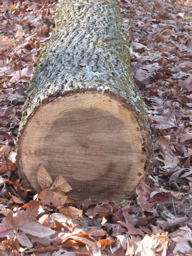
The
wood is hard, heavy, strong, and very flexible, making it
a favored wood for tool handles. It is distinctive because
of the rich brown center you will see when the wood is cut.
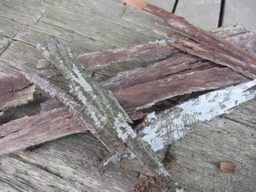
The
barks is also distinctive as it has a rich brown color on
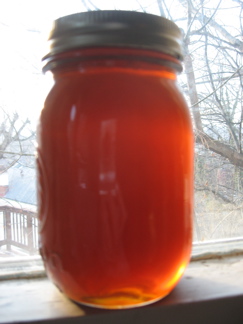
the backside. We use it to make our Shagbark Hickory Syrup.
|
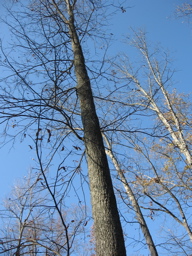
PIGNUT
HICKORY
We have pignut hickory trees as well. They
are prolific producers of pignuts which will readily sprout
into seedlings.
Classification:
Carya glabra (pignut hickory): This tree has medium green
broad, flat leaves and firm, gray bark. The bark has a diamond
pattern. This tree grows well in fairly rich, well drained
to dry soils. It occurs with other hickories and with oaks.
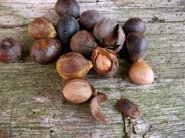
The
nuts of this particular hickory, are bitter and are enjoyed
by many forest animals.
|
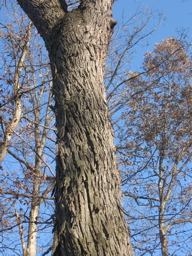
SHELLBARK
HICKORY
Growing right along with the shagbarks are shellbark hickory
trees. Not as shaggy as the shagbarks, but taller and fuller.
Classification:
Carya laciniosa (shellbark hickory or kingnut hickory):This
deciduous tree is similar to that of the Shagbark Hickory,
but often not quite as shaggy. This tree and it prefers
wet, fertile bottomland and I found them growing by our
pond and the streams that feed the pond. Like other hickories,
it is very tolerant of summer drought.
|

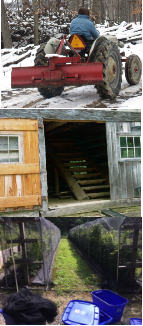
 HICKORY
PRODUCTION
HICKORY
PRODUCTION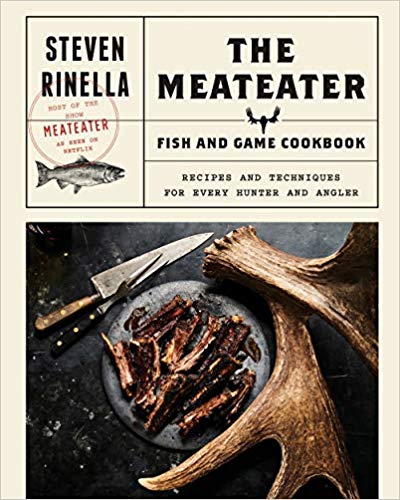




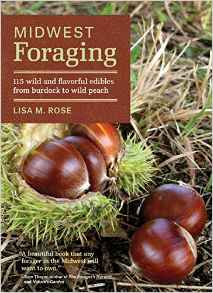 Midwest
Foraging: 115 Wild and Flavorful Edibles from Burdock
to Wild Peach (Timber Press Field Guide)
Midwest
Foraging: 115 Wild and Flavorful Edibles from Burdock
to Wild Peach (Timber Press Field Guide)